FatBet trust and licensing: casino vs Australian bookmaker explained
 Available in AU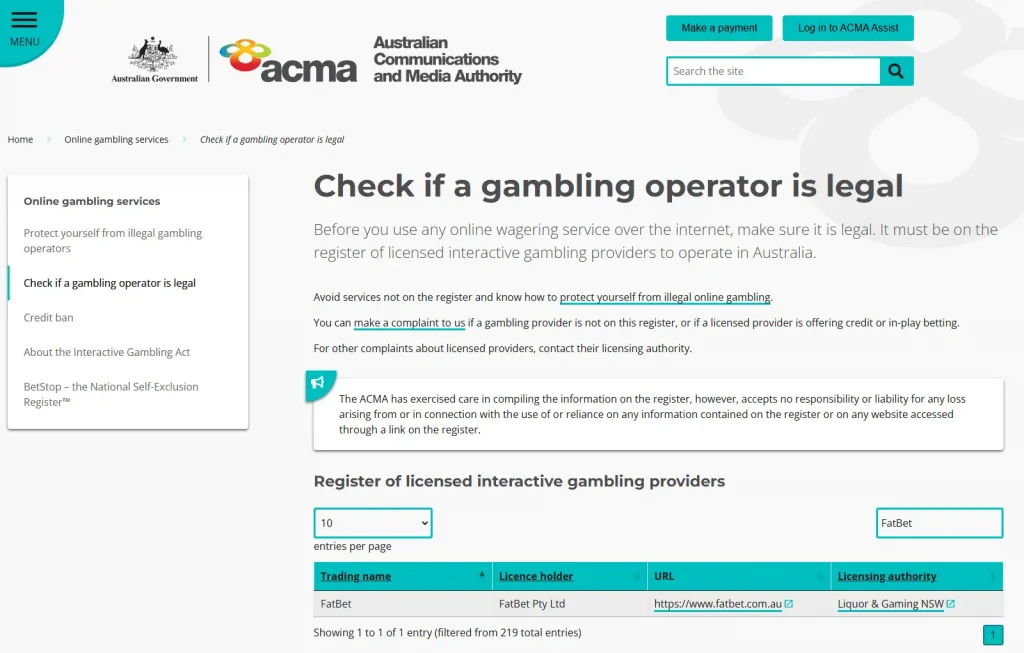
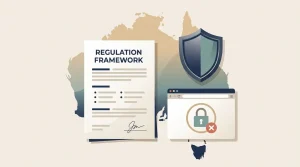
No Australian local licence was verified for the FatBet casino brand in ACMA’s wagering register. The register does contain a current entry named FatBet, but that entry is for FatBet Pty Ltd, points to fatbet.com.au, and lists Liquor & Gaming NSW as the licensing authority. That is a separate entity and domain from the FatBet casino discussed here.
This distinction is the central trust issue. A matching brand name is not enough to transfer a licence from one operator or domain to another. Current independent casino pages also contain Curaçao-related claims about the casino, but the public records did not establish a current regulator-domain entry that would support publishing an active Curaçao licence as fact. The practical focus is entity identity and licence evidence rather than a blanket safe-or-unsafe label.
Table of Contents
- What the ACMA register actually shows
- Why FatBet is unusually easy to misidentify in Australia
- Register hit vs name match: the evidence test
- No Australian local licence verified for the casino brand
- What about Curaçao licence claims?
- Australian law is broader than one licence search
- Operational access is not the same as regulatory approval
- What an Australian reader can verify independently
- Consumer-protection implications of an unverified local licence
- What this licence evidence does not tell you
- How to assess FatBet licence evidence
- Frequently asked questions
- FatBet trust and licensing: casino vs Australian bookmaker explained
What the ACMA register actually shows
ACMA maintains a public register for licensed interactive wagering providers. In the current register, the name FatBet appears alongside FatBet Pty Ltd, the domain fatbet.com.au and Liquor & Gaming NSW. That is strong evidence for the identity and licensing context of that Australian wagering business.
It is not evidence that a different casino website with a similar name inherits the same licence. A register check has to match the relevant legal entity, domain and product context. If those identifiers do not line up, the responsible reading is that the register entry belongs to the listed operator only.
You can inspect the current register directly on the ACMA legal wagering register. The key fields are the service name, company name, web address and regulator. Reading all four prevents a brand-name collision from becoming a false licensing claim.
Why FatBet is unusually easy to misidentify in Australia
Search results for FatBet in Australia mix references to the casino with references to the separate Australian wagering operator. That creates a simple but serious entity-resolution problem. A reader searching for “FatBet licence Australia” can encounter a genuine ACMA-listed FatBet result and reasonably assume it applies to every service using the same name.
The evidence does not support that assumption. The ACMA-listed business is FatBet Pty Ltd and its listed website is fatbet.com.au. The published details about the casino concerns the separate FatBet casino identity historically associated with fatbet.com. Similar names are not proof of shared ownership, shared licensing or shared consumer protections.
This is why the site does not use a licence badge based on the word “FatBet” alone. Entity identity has to be established before a regulatory status can be transferred to a service.
Register hit vs name match: the evidence test
A proper licensing check is more demanding than finding the right word in a regulator search. A useful register hit should connect the service being reviewed to the legal entity and domain that the regulator lists. At minimum, ask whether the following pieces fit together:
- Brand or service name: does the register name the relevant service?
- Legal entity: is the company operating the service identified?
- Domain: does the regulator entry point to the website being reviewed?
- Licence authority: is the regulator or state authority clearly shown?
- Product scope: is the licence for the type of gambling service actually being discussed?
For the Australian FatBet entry, the entity and domain point to the bookmaker at fatbet.com.au. The casino does not become part of that licence simply because it shares the brand name.
No Australian local licence verified for the casino brand
The licence-checking approach treats local licensing as a dedicated fact that requires regulator evidence. On the current ACMA register check, no Australian local licence was verified for the FatBet casino entity discussed here. That statement is deliberately narrower than saying the casino is globally unlicensed or making a general legal label for every interaction with the brand.
Local licence status also does not determine unrelated product facts. Whether a casino has a particular game provider, payment category, mobile experience or bonus structure must be verified separately. The absence of a verified Australian casino licence does not make those independent facts automatically false, and it should not force hedging into every product section.
Licensing should be assessed separately from games, payments, support and mobile functionality because each area depends on different information.
What about Curaçao licence claims?
Several independent casino listings associate FatBet Casino with Curaçao licensing. However, the current public records did not establish a regulator-domain match that would support presenting an active Curaçao licence as a verified fact. One current independent listing also disputes the licence claim. Because the evidence conflicts on a sensitive regulatory detail, no licence number, active-status claim or expiry date is stated.
That does not justify replacing uncertainty with a stronger claim in the other direction. The appropriate statement is simply that a current Curaçao licence for the casino was not established by a regulator-domain record in the public information. If a future regulator entry clearly links the casino domain and operating entity, that evidence can be reassessed.
For readers, the practical lesson is to prefer regulator-domain evidence over licence badges copied between review sites. A repeated claim can still be wrong if multiple sites rely on the same unverified source.
Australian law is broader than one licence search
ACMA says the Interactive Gambling Act 2001 makes it illegal for gambling providers to offer certain online services to people in Australia, including online casinos. ACMA also distinguishes those prohibited interactive gambling services from regulated wagering services, which can operate within a licensing framework.
That is why the existence of a licensed Australian wagering operator called FatBet does not establish that an online casino with the same name is authorised to provide casino services. Product category matters as well as entity identity.
The focus here is the FatBet entity and licence evidence. The broader rules, enforcement model and consumer context are covered on the Australian online casino law guide. ACMA’s current overview of the legislation is also available on its Interactive Gambling Act information page.
Operational access is not the same as regulatory approval
A website can be accessible, can accept a registration attempt, or can be promoted by third-party sites to Australian readers without that establishing Australian licensing. These are different evidence dimensions. Technical access answers whether a site can be reached. Registration support answers whether an account can be created. Licensing answers whether the relevant regulator has authorised the service under the applicable framework.
The same separation applies to payments. Seeing AUD, a bank-transfer option or cryptocurrency support does not create a regulatory licence. For the practical banking side, see the payment methods guide and the separate withdrawals guide.
Keeping these facts separate prevents a common review error: treating a familiar local signal as proof of local legal status.
What an Australian reader can verify independently
- Search the ACMA wagering register for the service name.
- Check the legal entity attached to the result, not just the display name.
- Compare the listed domain with the exact website you are researching.
- Identify the regulator or licensing authority shown in the entry.
- Check whether the licence scope matches wagering, lotteries or another product rather than assuming it covers online casino games.
- If an offshore licence is claimed, locate the regulator’s own register or official domain-verification tool.
- Do not treat a licence logo, footer badge or affiliate review as equivalent to a regulator record.
- Keep account verification separate from licensing: a KYC request proves nothing about whether the operator is authorised in Australia.
These checks are intentionally simple. Their purpose is not to produce a score but to make the evidence chain visible enough that readers can judge it themselves.
Consumer-protection implications of an unverified local licence
Without a verified Australian local licence for the casino entity, there is no basis to assume that Australian wagering protections, local dispute channels or regulator-supervised account safeguards apply to the casino. Those protections should be tied to a confirmed licensing relationship, not inferred from a similar name.
That makes record-keeping more important if a reader chooses to interact with an offshore service. Save terms that matter to the decision, keep payment confirmations, retain verification correspondence and record support case numbers. These steps do not create regulatory protection, but they preserve evidence about what the service represented and what happened to the account.
The account verification guide explains how identity checks fit into that record trail without claiming a fixed KYC document list.
What this licence evidence does not tell you
Licence evidence does not answer every product question. It does not tell you how many games are in the lobby, whether a particular payment method is shown today, whether a mobile app exists, or what a current promotion contains. Those claims need their own supporting information.
Likewise, a payment method or familiar game provider does not prove a licence. Evidence should flow in the correct direction: regulator records support regulatory claims; payment sources support payment claims; game sources support game-library claims.
This separation is especially useful when reviewing older casinos, redirected domains or brands with multiple similarly named services. It reduces the chance that one correct fact is stretched into several unsupported claims.
How to assess FatBet licence evidence
The strongest verified Australian licence evidence belongs to FatBet Pty Ltd at fatbet.com.au, a separate wagering operator listed in ACMA’s register. It should not be transferred to the FatBet casino merely because the brand name matches. No Australian local licence was verified for the casino entity, and current Curaçao claims remain unresolved without a regulator-domain match. For trust evidence, the important habit is therefore to match brand, legal entity, domain, product scope and regulator before treating any licence claim as established.
For the broader related context, see FatBet Australia review.
Frequently asked questions
Does FatBet Casino have an Australian licence?
No Australian local licence was verified for the FatBet casino entity in the current ACMA wagering register check.
What is the FatBet entry in the ACMA register?
It is an entry for FatBet Pty Ltd at fatbet.com.au, with Liquor & Gaming NSW listed as the relevant authority. That is treated as a separate Australian wagering operator.
Is FatBet Pty Ltd the same company as FatBet Casino?
The published details do not establish that they are the same entity. The domain and regulatory context in the ACMA entry point to the Australian wagering operator, not the casino discussed here.
Does FatBet Casino have a Curaçao licence?
Independent casino listings make Curaçao-related claims, but a current regulator-domain match is not established and the third-party record is conflicting. The published details therefore does not establish an active Curaçao licence or licence number as fact.
Is FatBet Casino legal or safe for Australians?
The evidence should not be reduced to a single label. ACMA’s rules, the lack of a verified Australian local licence for the casino entity, the separate FatBet Pty Ltd register entry and the unresolved offshore licence claim are presented separately so readers can assess the position.