FatBet and Australian online casino law: ACMA rules explained
 Available in AU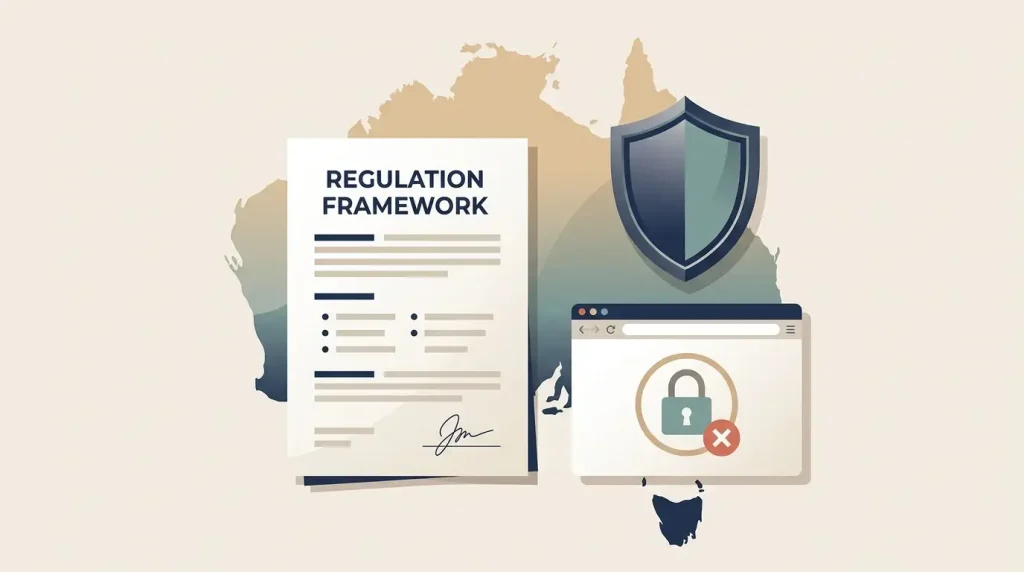
Australian law does not treat every form of online gambling in the same way. Under the Interactive Gambling Act 2001, providers must not offer prohibited interactive gambling services such as online casino-style games to customers physically present in Australia. Licensed online wagering is treated separately, which is why an Australian betting operator can appear in the legal wagering register while online casino services remain prohibited for providers.
For a reader researching an offshore casino such as FatBet, the useful question is therefore not simply whether “online gambling is legal”. The important distinctions are the type of service, whether it is licensed within the Australian wagering framework, what ACMA can enforce against providers and websites, and which consumer-protection systems actually apply. Those distinctions are explained using current Australian primary sources rather than treating accessibility as proof of regulatory approval.
Table of Contents
- The core rule: online casino services are prohibited for providers
- Why licensed wagering is different from an online casino
- What ACMA does
- Advertising prohibited interactive gambling services
- Website blocking is not the same as a complete legal-status test
- BetStop: useful protection, but its scope is specific
- The 2026 gambling reforms and the 1 January 2027 date
- What the reforms mean for a casino review today
- How this affects payments and withdrawals
- Account checks and KYC do not establish legality
- Gambling winnings and Australian tax
- A practical evidence checklist for Australian readers
- What the Australian rules mean in practice
- Frequently asked questions
- Recommend
The core rule: online casino services are prohibited for providers
ACMA’s current guidance states that the Interactive Gambling Act 2001 regulates online gambling services offered to people in Australia. The Act prohibits providers from supplying certain interactive gambling services to Australian customers. Online casino services are among the clearest examples. The regulator has repeatedly described online casinos, online slots and similar casino-style games as prohibited interactive gambling services when supplied to customers in Australia.
This is a provider-and-service rule, and that wording matters. It is more precise than saying that all online gambling is illegal in Australia or making an unsupported statement about the personal criminal liability of an individual player. Australian law has separate categories for different services. Licensed interactive wagering can operate within a state or territory licensing framework, while prohibited interactive gambling services cannot lawfully be offered to Australian customers merely because the operator is based offshore.
ACMA’s Interactive Gambling Act overview is the most useful starting point for the current federal position. The legislation itself is published through the Federal Register of Legislation.
Why licensed wagering is different from an online casino
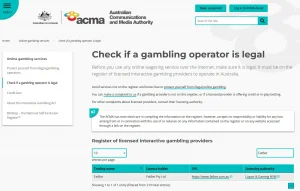
Australia has a register of licensed interactive wagering providers. These services are not equivalent to online casinos. A wagering operator may be licensed by an Australian state or territory authority and appear in ACMA’s register, while casino-style interactive games remain in a prohibited category under federal law.
This distinction is particularly relevant to the FatBet name. As explained in the separate FatBet licence and trust guide, ACMA’s wagering register contains a FatBet entry associated with FatBet Pty Ltd and fatbet.com.au. That register entry concerns the listed wagering business. It should not be transferred to a separate casino service simply because the same or similar brand name appears elsewhere.
In practical terms, a licence check needs to match the legal entity, website domain and product type. A legitimate Australian wagering licence is evidence for that wagering service. It is not a general permission slip for online casino products.
What ACMA does
The Australian Communications and Media Authority is the Commonwealth regulator responsible for enforcing the federal interactive-gambling rules. ACMA investigates services that may be operating or advertising contrary to the Interactive Gambling Act, publishes enforcement information and can use disruption measures against illegal services.
One of the most visible tools is website blocking. ACMA can request that Australian internet service providers block access to gambling websites after investigations find that the services are operating in breach of the Act. The regulator has used this mechanism repeatedly since 2019 and continues to publish new blocking actions.
A block is therefore an enforcement action against a service or website. The reverse inference is not valid: a site being reachable from Australia does not mean ACMA has licensed or approved it. Blocking is an enforcement mechanism, not a complete real-time whitelist of every site that may be technically accessible.
Current enforcement updates can be checked through ACMA’s blocked gambling websites information and its interactive-gambling compliance publications.
Advertising prohibited interactive gambling services
Australian rules also restrict advertising for prohibited interactive gambling services. ACMA states that advertising prohibited services, including online casino-style services, is banned. This matters because marketing visibility should not be confused with legal status. An offshore casino may still appear in search results, social media, affiliate content or other online promotion even though the service category itself cannot lawfully be supplied to customers in Australia.
For readers, the practical distinction is between exposure and authorisation. Seeing a casino advertised to Australians does not establish that the operator is licensed in Australia. Likewise, seeing an AUD label, an Australian-themed page or a local-looking promotion is not regulatory evidence.
When assessing marketing claims, use official regulatory records for licensing questions and treat promotional material as evidence only of what is being advertised, not of whether that service is authorised.
Website blocking is not the same as a complete legal-status test
ACMA’s blocking program is an important enforcement tool, but readers should understand what it can and cannot tell them. When ACMA announces that a website has been blocked, it is strong evidence that the regulator found the service to be operating contrary to Australian interactive-gambling law. But the absence of a particular domain from a published blocking list is not evidence that the site is approved.
Enforcement is necessarily selective and ongoing. Domains can change, operators can move services, and investigations occur over time. That is why the stronger method is to start with the service category and the licensing framework rather than searching only for a brand name on a blocking list.
The same principle applies to technical access. A website loading successfully says something about connectivity, not about permission to offer the service. Regulatory status and technical availability are separate questions.
BetStop: useful protection, but its scope is specific
BetStop – the National Self-Exclusion Register allows a person to self-exclude from licensed Australian online and phone wagering providers through one registration. The official BetStop service states that, while a person is registered, covered wagering providers must not allow betting, open new wagering accounts or send marketing material.
Its scope should not be overstated. BetStop covers providers licensed to offer online and phone wagering in Australia. BetStop’s own guidance says it does not apply to online casino games or other gambling services that are illegally provided in Australia. That means a person should not assume that registering with BetStop automatically blocks every offshore casino website or account.
This distinction makes self-exclusion planning more important, not less. Someone who wants to limit gambling access may need to combine BetStop with device-level blocking, financial controls and support services where offshore or unlicensed services fall outside the register’s coverage.
The 2026 gambling reforms and the 1 January 2027 date
Australian Parliament passed the Interactive Gambling Amendment (Gambling Reform) Bill 2026 on 19 August 2026. The resulting Act received assent on 26 August 2026. ACMA says most of the reforms are scheduled to commence on 1 January 2027.
The package is broad. ACMA’s current summary includes restrictions on wagering advertising, a gambling-advertising opt-out register, changes to direct marketing of inducements, stronger enforcement tools for illegal gambling services, changes designed to strengthen BetStop, restrictions involving affiliate and staff commissions, and measures addressing some online lottery products.
Because the date is before 1 January 2027, it would be inaccurate to assume that all of those measures are already operating in their final post-commencement form. The Act is now law, but commencement timing still matters for particular provisions. The Federal Register of Legislation entry for the 2026 Act and ACMA’s current guidance should be checked again after commencement if a specific new obligation becomes material.
What the reforms mean for a casino review today
The 2026 reforms do not change the basic method for evaluating an offshore casino today. Start by identifying the service being offered, then separate that from Australian-licensed wagering. Check the regulator’s own material for local authorisation and use ACMA enforcement information for prohibited services. Do not use a similarly named licensed bookmaker, a local currency option or simple website access as a substitute for regulatory evidence.
The reforms do, however, show that Australia’s online-gambling framework is still evolving. Advertising, illegal-service disruption and self-exclusion are active policy areas. Readers revisiting this information after 1 January 2027 should therefore pay particular attention to ACMA’s implementation guidance rather than relying on older summaries.
How this affects payments and withdrawals
Australian regulatory status does not by itself tell you which payment methods a casino offers, whether a withdrawal method is available or how long processing will take. Those are separate product facts. The FatBet payments guide covers the payment evidence available for the brand, while the withdrawals guide explains why exact limits, fees and processing times need stronger evidence than broad payment-category claims.
From a regulatory perspective, the useful lesson is simpler: a payment working from Australia is not evidence that the underlying casino service is licensed in Australia. Payment access, website access and regulatory authorisation should not be collapsed into one assumption.
Account checks and KYC do not establish legality
Identity verification is another area where readers can draw the wrong inference. An operator asking for proof of identity, age, address or payment ownership does not demonstrate that the operator holds an Australian licence. KYC is an account-control process, while licensing is a regulatory status that must be established independently.
The FatBet account and KYC guide keeps those questions separate. That is particularly useful when an offshore service requests documents: the fact that verification occurs may be relevant to account administration, but it does not create ACMA oversight or make Australian dispute mechanisms automatically available.
Gambling winnings and Australian tax
Australian tax treatment is often reduced to the slogan that gambling winnings are “tax free”, but that is too absolute. Australian Taxation Office material supports a narrower general principle: winnings from recreational betting or gambling are generally not assessable income, and related losses are generally not deductible. Different treatment can apply where the gambling activity amounts to carrying on a business.
That is a general tax distinction, not personal tax advice or a guarantee for every set of circumstances. Frequency, organisation, scale and the commercial character of activity can matter when determining whether gambling is a business. Anyone whose activity is substantial or business-like should use current ATO guidance or professional tax advice rather than relying on a casino review.
The relevant ATO legal material is available through the Australian Taxation Office legal database.
A practical evidence checklist for Australian readers
- Identify the product. Separate online casino games from sports or racing wagering, lotteries and other gambling categories.
- Check the operator, not just the brand name. Match legal entity and domain before relying on a register entry.
- Use ACMA for the federal interactive-gambling framework. Do not substitute affiliate reviews for regulator material on legal status.
- Treat blocking lists correctly. A listed block is meaningful enforcement evidence; absence from a list is not approval.
- Check BetStop’s coverage before relying on it. Its protection is tied to licensed Australian online and phone wagering providers.
- Separate product evidence from legal evidence. AUD support, deposits, games or KYC processes do not prove an Australian licence.
- Check reforms after commencement dates. Rules scheduled for 1 January 2027 should be read in their post-commencement form once that date arrives.
- Use ATO material for tax questions. Avoid universal claims about winnings without considering whether gambling is recreational or business-like.
What the Australian rules mean in practice
For Australians assessing an offshore casino such as FatBet, the key legal distinction is between prohibited online casino-style services and Australian-licensed wagering. ACMA enforces the federal Interactive Gambling Act and can pursue measures including website blocking, while BetStop protects users across licensed Australian online and phone wagering providers rather than automatically covering offshore casinos. The 2026 reform Act adds further changes, most scheduled to commence on 1 January 2027.
Use those regulatory facts separately from the brand-specific licence evidence in the FatBet trust guide. That approach avoids two common mistakes: treating a reachable website as approved, and treating a similarly named licensed wagering business as proof that a casino service is licensed too.
For the broader related context, see FatBet Australia review.
Frequently asked questions
Are all forms of online gambling illegal in Australia?
No. Australian law distinguishes service types. Online casino-style interactive gambling is prohibited for providers to offer to customers in Australia, while licensed online wagering operates under a separate framework.
Does ACMA license online casinos?
The Australian framework does not turn prohibited online casino services into licensed Australian wagering services. ACMA maintains the register used to check licensed interactive wagering providers and enforces the federal Interactive Gambling Act.
If a casino website loads in Australia, does that mean it is legal?
No. Technical accessibility is not the same as regulatory authorisation. ACMA can investigate and seek blocking of services operating in breach of the Act.
Does BetStop block offshore online casinos?
BetStop covers licensed Australian online and phone wagering providers. Its official guidance says it does not apply to online casino games or other gambling services that are illegally provided in Australia.
What changes on 1 January 2027?
ACMA says most measures in the 2026 gambling reform package commence on 1 January 2027. The reforms cover areas including wagering advertising, illegal-service disruption, BetStop and other consumer-protection measures.
Are casino winnings always tax free in Australia?
No universal guarantee should be made. ATO material indicates that recreational gambling winnings are generally not assessable income, while different treatment can apply if the activity constitutes a gambling business.
Recommend
FatBet trust and licensing: casino vs Australian bookmaker explained
No Australian local licence was verified for the FatBet casino brand in ACMA's wagering register....

FatBet account, registration and KYC checks
FatBet is marketed to Australian players by multiple Australia-focused independent casino listings, but that marketing...

FatBet bonuses in Australia: offers and terms to check
FatBet Casino has been repeatedly associated with deposit-match promotions and free-spin offers, but the exact...

FatBet games and pokies: providers, tables and casino categories
FatBet Casino is consistently described as a pokies and casino-games site with both slot-style content...

FatBet payment methods in Australia: cards, bank transfer and crypto
Cards, bank transfer and cryptocurrency are the payment categories most consistently associated with FatBet Casino...

FatBet mobile casino: browser play, iPhone and Android
FatBet Casino is consistently described as usable through mobile browsers on iPhone and Android-class devices....